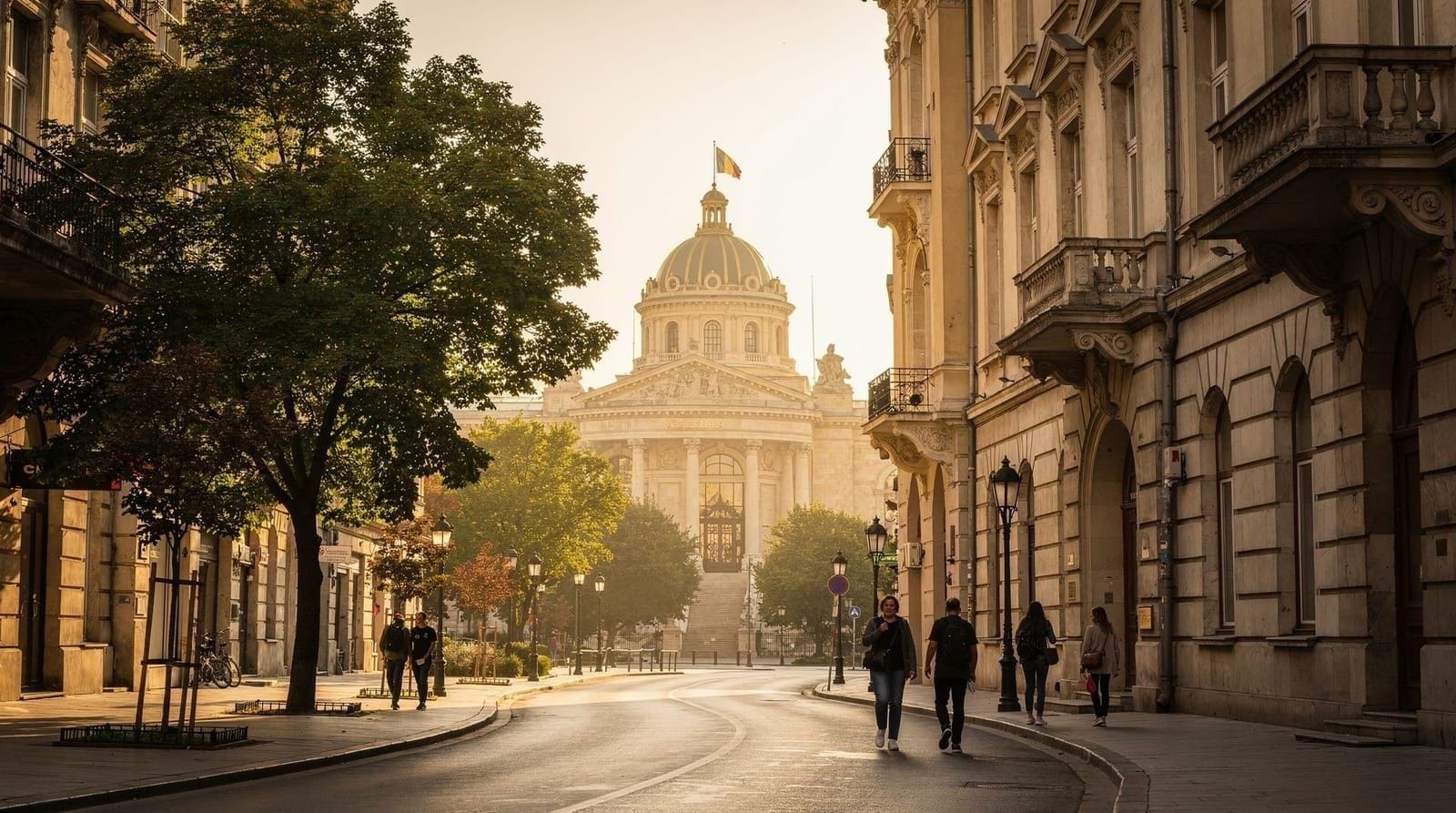
Bucharest old town walking tour — which option is actually worth booking?
The secret Bucharest half-day walking tour
Bucharest’s old town (Lipscani) takes about 20 minutes to walk end to end. It takes about three days of reading or an hour with a good guide to actually understand it. The neighbourhood has been a trading post since the 15th century, a diplomatic hub in the 19th, a Little Paris in the 1920s and 1930s, a half-demolished construction site under Ceaușescu, and a chaotic post-communist reinvention as a bar district before its current incarnation as a tourist destination. That compressed history is why a walking tour earns its price here.
| Where | Lipscani old town, central Bucharest |
| Time needed | 2–2.5 hours (standard); 3–4 hours extended |
| Cost | Around 80–230 RON per person depending on format |
| Best time | Morning departures (9:00–10:00) in summer to avoid heat |
| Booking | Not usually required more than a day ahead |
What you see on a standard old town walking tour
Most 2–2.5 hour tours cover the same core route with individual variations by guide. Key stops:
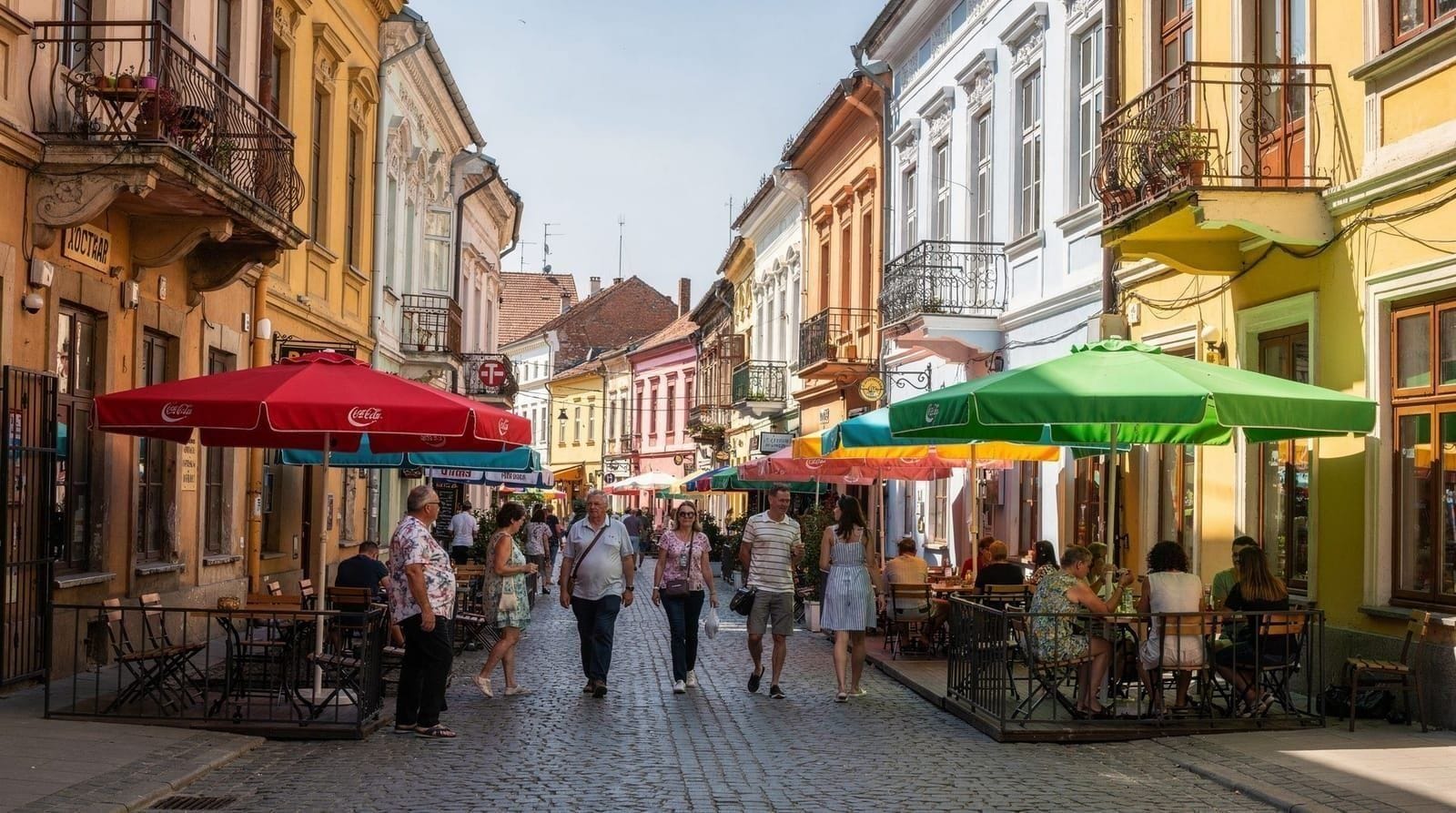
Lipscani street — the historic centre named after the Leipzig merchants (Lipsia = Leipzig in Romanian) who traded here from the 16th century. The name stuck long after the Saxons left. The current street is a pedestrianised mix of restored 18th-century facades, craft shops, and bars.
Curtea Veche (Old Princely Court ruins) — the excavated remains of a 15th-century palace, partially visible below street level. Vlad Țepeș, the historical Dracula, held court here. A good guide makes this a genuinely interesting stop; a rushed guide treats it as a photo point.
Stavropoleos Church — built in 1724 in neo-Byzantine style, with carved stone arches and courtyard frescoes that survived the communist period largely intact. One of the most beautiful small buildings in Bucharest and often overlooked by independent visitors. Worth slowing down here.
Hanul lui Manuc — a 19th-century caravanserai (merchant inn) built by an Armenian merchant, now operating as a hotel and restaurant around a colonnaded courtyard. The Treaty of Bucharest was signed here in 1812. The courtyard is public and photogenic.
National Bank of Romania — a neoclassical building from 1900 modelled loosely on the Bank of France. The exterior is impressive; tours discuss its role in Romania’s economic history.
Tours that extend to Calea Victoriei add the Romanian Athenaeum (a spectacular concert hall), Revolution Square (the sites of the 1989 uprising), and the Cantacuzino Palace.
A Tale of Bucharest — best-rated group walking tourSmall group versus large group tours
The difference in experience between a 20-person group and an 8-person group is significant in narrow Lipscani alleyways. The best-rated walking tours cap at 12 people. Check group size limits before booking — they are usually in the listing details.
Small group walking tour (max 12) — Old Town and Calea VictorieiHidden gems and alternative routes
Some tours deliberately skip the well-worn Lipscani route and explore the surrounding neighbourhoods: the Jewish quarter around Strada Iuliu Maniu, the Art Deco apartment buildings of central Bucharest, and the covered passage galleries (pasaje) modelled on Parisian arcades that still survive in various states of repair.
The old town guide on this site covers these alternative angles for self-guided exploration. The Calea Victoriei guide complements the walking tour for the boulevard stretch.
Hidden gems walking tour — beyond the standard routePrivate walking tours
Private tours for 2–4 people cost 250–450 RON (50–90 EUR) per person and include a Romanian snack at a traditional spot. Worth booking if you have specific questions — architecture, the interwar period, Jewish Bucharest, communism’s impact on the old town — or if you are travelling as a couple and want conversation rather than a lecture to a group.
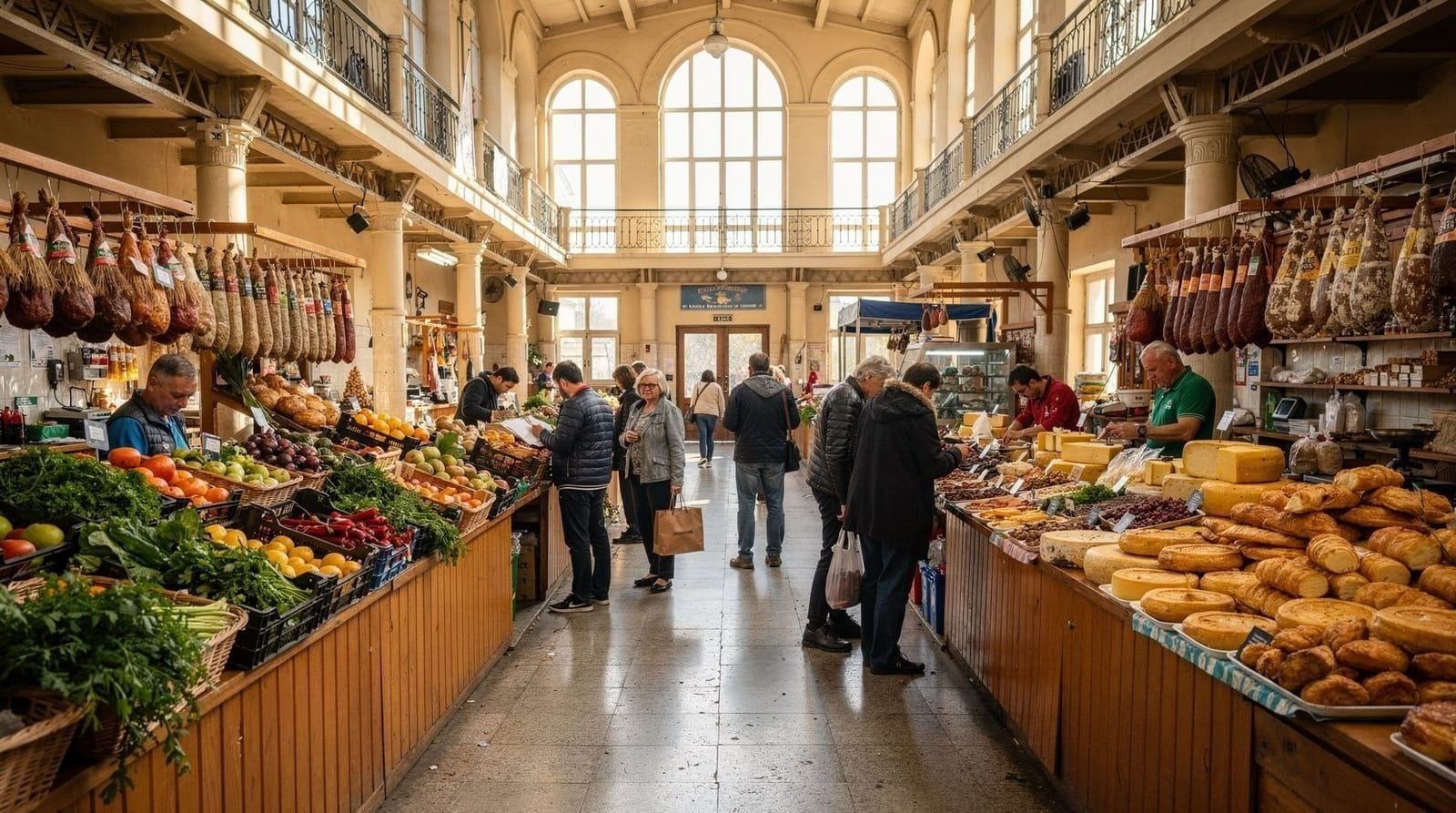
The private tour with a Romanian snack included is one of the better-value private options: the guided tasting at a genuine local shop or bakery is a useful anchor point that most guides handle well.
Prices in RON and EUR (2026)
- Free walking tours (tip-based): exist and are genuinely run by knowledgeable guides, but group sizes reach 30+ people and routes are compressed. Worth it on a tight budget.
- Paid group tour (2–2.5 hours): 80–150 RON (16–30 EUR) per person
- Small group tour capped at 12: 120–180 RON (24–36 EUR) per person
- Extended tour with Calea Victoriei (3–4 hours): 150–230 RON (30–46 EUR)
- Private tour for 2 people: 500–900 RON total (100–180 EUR)
Honest verdict
Walking tours of the old town are one of the better tour purchases in Bucharest — the history is dense enough to justify a guide, the routes are walkable even on a warm day, and the best operators offer genuinely knowledgeable guides rather than scripted commentary. The experience is much weaker in groups over 15 people.
What to watch for: some budget tours (sub-80 RON / 16 EUR) move fast enough that Stavropoleos Church is a 5-minute photo stop rather than a genuine explanation. If you care about the architecture, pay a little more for a guide who is comfortable slowing down.
The best complement to a walking tour is the Bucharest food guide and a reservation at one of the old town’s better restaurants for that evening — the tour will give you context for the menus.
The Lipscani quarter in detail
Lipscani is not one street — it is a dense web of specialist trading lanes that each took their name from the merchants who worked them. Understanding the street names turns a walk through what looks like a generic pedestrian zone into something more legible.
Strada Lipscani itself was the main artery of the Leipzig merchants (Lipsia in Romanian), who brought Bohemian glassware and Central European silverware into Wallachia from the 16th century onward. The name survived long after the Saxons left. Today the street is pedestrianised and lined with restored 18th-century facades — the stonework above the bars and souvenir shops is genuinely old even when the ground-floor fit-out is not.
Strada Șelari (Saddlemakers’ Street) ran parallel to Lipscani and housed the leather craftsmen who supplied the merchant caravans with harnesses, saddles, and bags. The street is shorter and quieter today, with several of its older building plots still showing the narrow frontages typical of craft-quarter lots — each artisan needed a small workshop with street access.
Strada Gabroveni takes its name from the Bulgarian town of Gabrovo, whose merchants traded here from the 17th century. It is one of the less restored streets in the quarter, which is part of its interest — the contrast between the spruced-up main drag and the peeling plasterwork on Gabroveni gives a better sense of what Lipscani looked like in the 1990s before the renovation wave.
Hanul cu Tei (Inn of the Linden Trees) is a surviving 19th-century caravanserai courtyard accessed through a narrow passage off Strada Lipscani. Where Hanul lui Manuc is now a hotel, Hanul cu Tei is a quieter space housing small shops and artisan studios. The courtyard structure — a central open space surrounded by two-storey colonnaded galleries where merchants stored goods below and slept above — is still legible even through the modern tenants. Most independent visitors walk straight past the entrance arch.
A walking tour makes the structural difference between the restored facades (which face the main pedestrian routes) and the unrestored back streets visible. The restored sections required years of structural reinforcement after decades of neglect; the unrestored sections are partly a planning backlog and partly a funding gap that the rapid bar-district commercialisation of the 2000s did not fully address.
Self-guided vs guided: what you miss on your own
Independent walking through Lipscani is straightforward — the area is compact, signposted, and the main monuments are findable. What is harder to see without guidance is the vertical dimension.
The Old Princely Court ruins (Curtea Veche) sit below the current street level by roughly a metre and a half. That is not just a quirk of excavation — it represents the accumulated debris of successive building cycles. The layer you are looking down at is 15th-century. Below it, detectable in the archaeological record though not visible to visitors, are the remains of an earlier 14th-century settlement and below that the remnants of 17th-century Ottoman structures that were already built on earlier foundations. An archaeologist or a guide who has worked with archaeologists can explain what these layers mean and why the city kept rebuilding rather than clearing and starting fresh. The sub-basement ruins, where preserved, require explanation to make sense of what you are actually looking at.
The Lipscani fire of 1847 is a critical event that shaped the modern street plan and that most visitors walk through without knowing. The fire swept through the wooden buildings of the commercial quarter and destroyed much of the pre-modern fabric. The rebuilding that followed in the 1850s and 1860s — using stone and brick, with the wider street intervals that fire risk required — is essentially the physical street plan that exists today. The slightly uniform character of the 19th-century facades on the main streets has a reason: they were built in a short burst of reconstruction after the same catastrophe.
The Jewish quarter stretched immediately adjacent to Lipscani, roughly along the streets running toward Piața Unirii. The community that traded here from at least the 17th century left a surviving monument in the Choral Temple on Strada Sfânta Vineri, built in 1857 in a Moorish Revival style. It is the main functioning synagogue remaining in Bucharest after communist-era demolitions reduced the number of synagogues in the city from over 100 to a handful. A guide who covers Jewish Bucharest will bring you here; an independent visitor needs to specifically seek it out.
Practical walking tour notes
Most organised walking tours meet at one of two points: Piața Unirii (the metro station exit at the northern edge of the square, near the fountain side) or the entrance to Caru’ cu Bere on Strada Stavropoleos 5, the 1879 Art Nouveau brasserie with the tiled vaulted interior. Confirm your specific meeting point when you book — operators vary, and showing up at the wrong end of Piața Unirii wastes 10 minutes you cannot easily recover on a fixed-time tour.
Weather is a real consideration. Bucharest reaches 35°C in July and August, and the old town has little shade cover on the main pedestrian streets. Morning tours (starting at 9:00 or 10:00) are significantly more comfortable than midday departures in summer — the temperature difference between 9:00 and 13:00 on a July day can be 8–10 degrees. If you are booking in summer and have flexibility, take the earliest available time slot.
Footwear matters: Lipscani and the surrounding streets are cobblestoned, and the cobbles are the old, irregular variety rather than the modern uniform type. Heels are impractical and genuinely uncomfortable over 2 hours. Flat-soled shoes or walking shoes with some cushioning make the difference between enjoying the tour and counting down to the end.
Tipping the guide is standard and expected on paid group tours. The going rate for a good performance on a group walking tour is 50–100 RON per person (10–20 EUR). On a free (tip-based) tour, the guide’s income is entirely the tip — 80–120 RON per person is appropriate if the tour was genuinely good. Private tour guides are typically tipped at the higher end of the range or beyond it if they went well above expectation. Cash in RON is easier than trying to tip by card.
Interwar Bucharest: the “Little Paris” layer
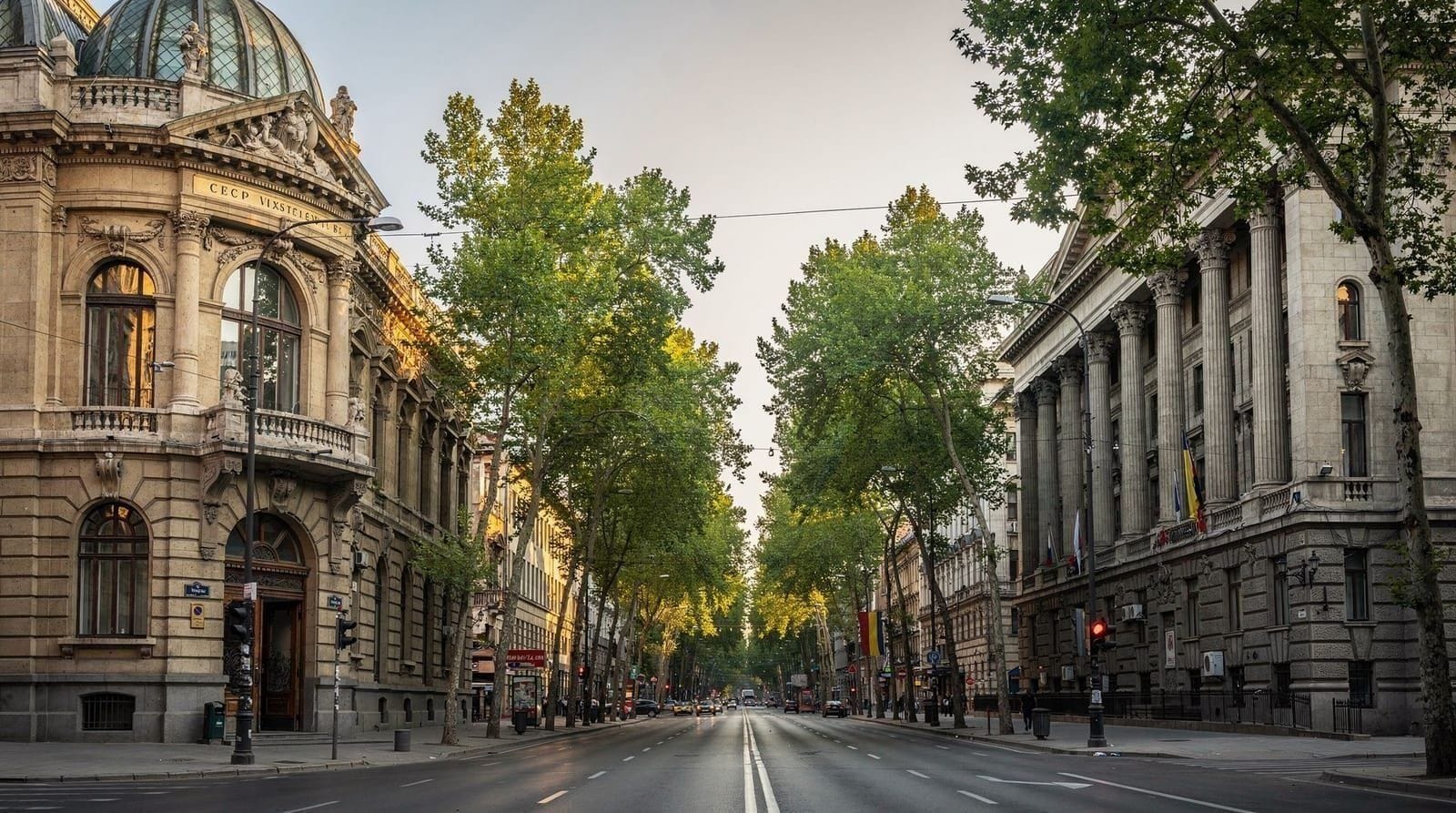
Between the medieval trading-post history and the communist demolitions, the old town and the streets immediately around it went through a period — roughly the 1900s to the 1930s — that earned Bucharest the nickname “Little Paris.” Wealthy Romanian families who had studied in Paris brought back Beaux-Arts and Art Nouveau architectural tastes, and central Bucharest filled with elegant apartment buildings, cafés, and boulevards modelled loosely on the French capital.
Much of this layer survives in fragments rather than as a coherent district: an ornate facade here, a wrought-iron balcony there, interspersed with communist-era infill and post-1989 renovation. A guide who knows the interwar period can point out details that are otherwise easy to walk past — the Art Nouveau ironwork on buildings just off Calea Victoriei, the surviving glass-roofed passages (pasaje) that echo Parisian arcades, and the cafés (a handful still operating in something close to their original form) where Bucharest’s interwar literary and political circles met. This layer is a useful complement to the medieval Lipscani story and to the communist narrative covered on the communist Bucharest tour — together the three periods explain most of what a first-time visitor sees walking through central Bucharest.
Combining the walking tour with a first Bucharest day
For visitors on a short trip, the old town walking tour works best as the opening activity of day one. It gives you a mental map of the city centre — where Lipscani sits relative to Calea Victoriei, where the Palace of Parliament and the Civic Centre lie beyond it, and which streets are safe for an evening return versus which to treat with the caution outlined in the Bucharest scams to avoid guide. The first-time Bucharest guide recommends exactly this sequencing: walking tour in the morning, free afternoon to revisit anything that caught your interest, dinner in the old town informed by what the guide pointed out.
Travellers building a longer itinerary can pair the old town walking tour with the Calea Victoriei guide for a self-guided extension the following day, covering the Athenaeum, Revolution Square, and the Cantacuzino Palace at a slower pace than a group tour allows.
Frequently asked questions about the Bucharest old town walking tour
Is a guided walking tour of Bucharest old town worth it?
For first-time visitors, yes. A good guide connects 500 years of history in 2 hours. You can walk Lipscani independently but you will miss the layers.
How long is a Bucharest old town walking tour?
Most group tours run 2–2.5 hours. Extended options covering Calea Victoriei run 3–4 hours.
What does the tour cover?
Lipscani street, the Old Princely Court ruins, Stavropoleos Church, Hanul lui Manuc, and the National Bank. Extended tours add the Athenaeum and Revolution Square on Calea Victoriei.
What is the difference between a group tour and a private tour?
Group tours cost 80–150 RON (16–30 EUR) per person with fixed routes. Private tours cost 250–450 RON (50–90 EUR) for the couple and allow customisation.
Are there walking tours that include food tastings?
Yes — dedicated food tours include 5–8 tastings over 3–4 hours. See the food tour review for details.
Is Bucharest old town safe for walking?
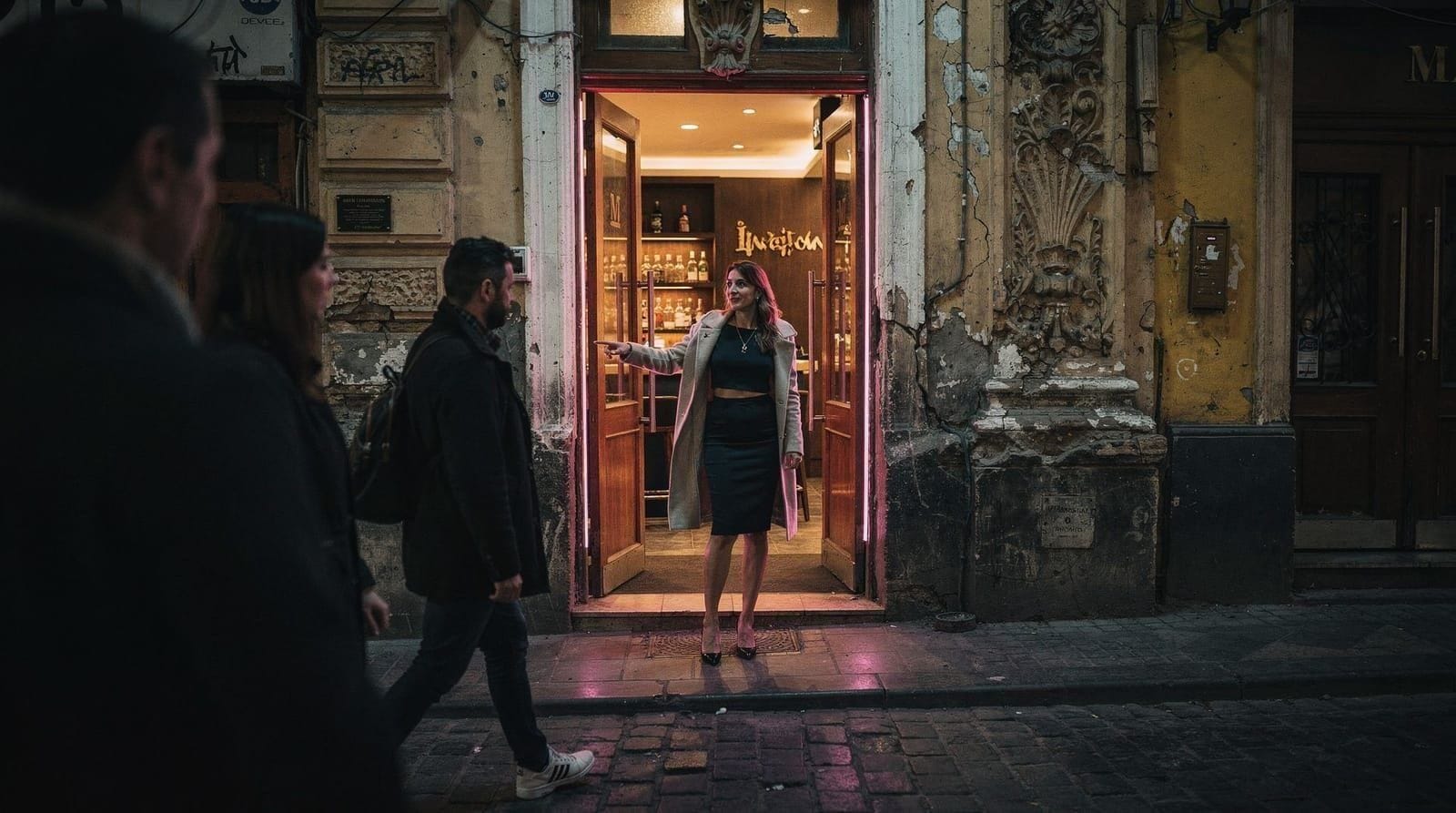
Yes. Be aware of the bar scam if walking alone at night — strangers may invite you to a club with vastly inflated prices. Read the old town bar scam guide before your visit.