Palace of Parliament tour — skip-the-line tickets and guided visits reviewed
Bucharest: Parliament palace skip the line ticket
Duration: 1 hour
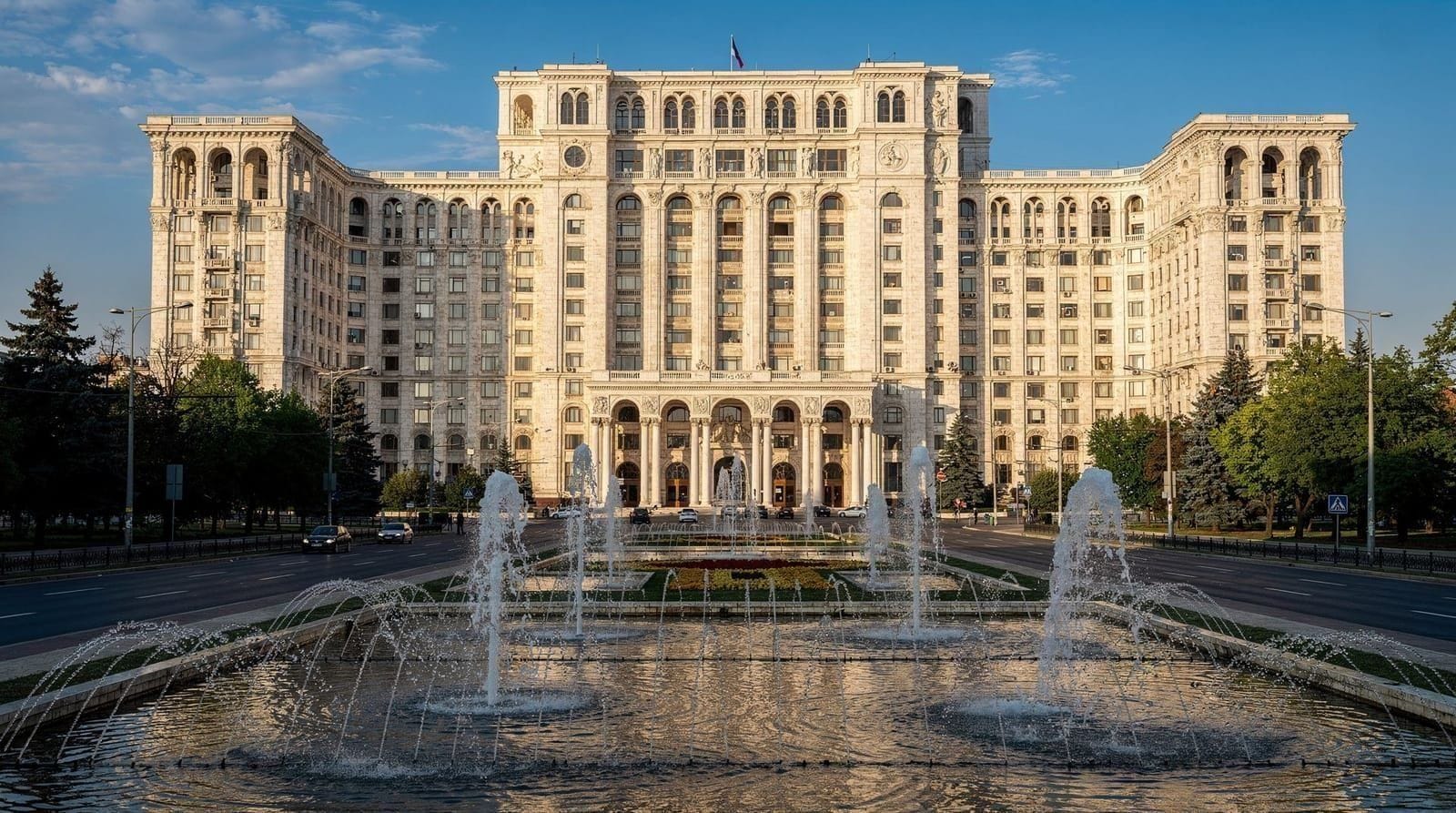
The Palace of Parliament is the second-largest administrative building in the world by floor space — bigger than the Pentagon, heavier than the Eiffel Tower (its marble alone weighs 1 million tonnes), and built at a cost that accelerated Romania’s debt crisis in the 1980s. If you visit Bucharest and skip it, you are missing the defining monument of Ceaușescu’s regime. But the ticketing options are confusing, the crowds are real, and not every tour on offer is worth the price.
| Where | Calea 13 Septembrie, entrance at Gate 1, Strada Izvor |
| Time needed | 1 hour (standard) to 2 hours (VIP private) |
| Cost | Official ticket 85 RON for adults; tours cost more |
| Getting there | Metro Izvor (M1), 10-minute walk, or a short taxi ride |
| Best time | Weekday mornings 9:00–11:00 for shortest queues |
What you actually get inside
The building has 12 floors above ground, 8 underground, 1,100 rooms, and 84 official suites. You will not see all of it. Standard public access covers a route through the main ceremonial halls — the Union Hall, the Human Rights Hall, and two or three of the grand corridors. That route represents perhaps 5% of the building, but it is the most photogenic 5%.
What makes the visit worthwhile is not the rooms themselves but the story behind them. The palace displaced 40,000 Bucharest residents in the 1980s, demolished a historic quarter including 19 Orthodox churches and 3 synagogues, and consumed roughly 40% of Romania’s GDP during construction. An informed guide turns that into a coherent, disturbing narrative. An audio guide or ticket-only visit gives you marble staircases and chandeliers without context.
Ticket types and real prices (2026)
The official ticket office is on site only (Strada Izvor 2-4) and the Palace is open daily 09:00–17:00. Tickets cost 85 RON (about 17 EUR) for adults, 55 RON for students aged 19–26 and 40 RON for children aged 7–18; under 7s are free. Bring your original ID card or passport (driving licences are refused). Photography is included. The queue on a typical summer morning can be 45–60 minutes.
Skip-the-line ticket (booked online): 90–110 RON (18–22 EUR). Eliminates the queue, same access route. Worth every leu between May and September.
Guided group tour: 120–160 RON (24–32 EUR) per person. Includes ticket and a shared guide — typically English, French, or German. Groups of up to 25 people. Duration around 1 hour.
Private guided tour: 160–250 RON (32–50 EUR) per person (varies by group size). Your own guide, more flexible routing, Q&A at any point. The VIP option adds access to the terrace and a couple of otherwise-closed ceremonial halls.
Skip-the-line ticket — book online Guided group tour with ticket includedWhich option is right for you?
First-time visitor with limited time: book the guided group tour. It costs only slightly more than a bare ticket, the queue is avoided, and you get enough context to understand what you are looking at.
Architecture or history enthusiast: the private tour justifies its price. Guides who specialise in communist-era architecture can explain the building’s stylistic contradictions (socialist realism blended with neo-Romanian motifs) and take you through halls not on the standard route.
Travelling with children under 10: the long corridors and strict no-running rules make this a challenging visit for young children. The Bucharest village museum or Herăstrău park are better alternatives for families.
On a tight budget: buy your ticket at the door and arrive before 9:30. The queue is manageable early in the day and you save the online booking fee.
Getting to the Palace of Parliament
The building is on Calea 13 Septembrie, a 20-minute walk from Bucharest’s old town or a 5-minute ride via Bolt. The nearest metro station is Izvor (M1 line), a 10-minute walk to the entrance. Taxis and Bolt cars can drop you at the main gate.
The tour entrance is at Gate 1 on Strada Izvor — not the imposing front facade on Bulevardul Unirii, which has no public entry. If you arrive at the wrong gate, you will waste 10–15 minutes walking around the building.
What to combine it with
The Palace of Parliament is naturally paired with a communist Bucharest tour, which takes you through the surrounding Civic Centre, past Ceaușescu’s residence, and explains the urban remodelling that created this neighbourhood. That full-day combination gives a complete picture of the 1980s regime.
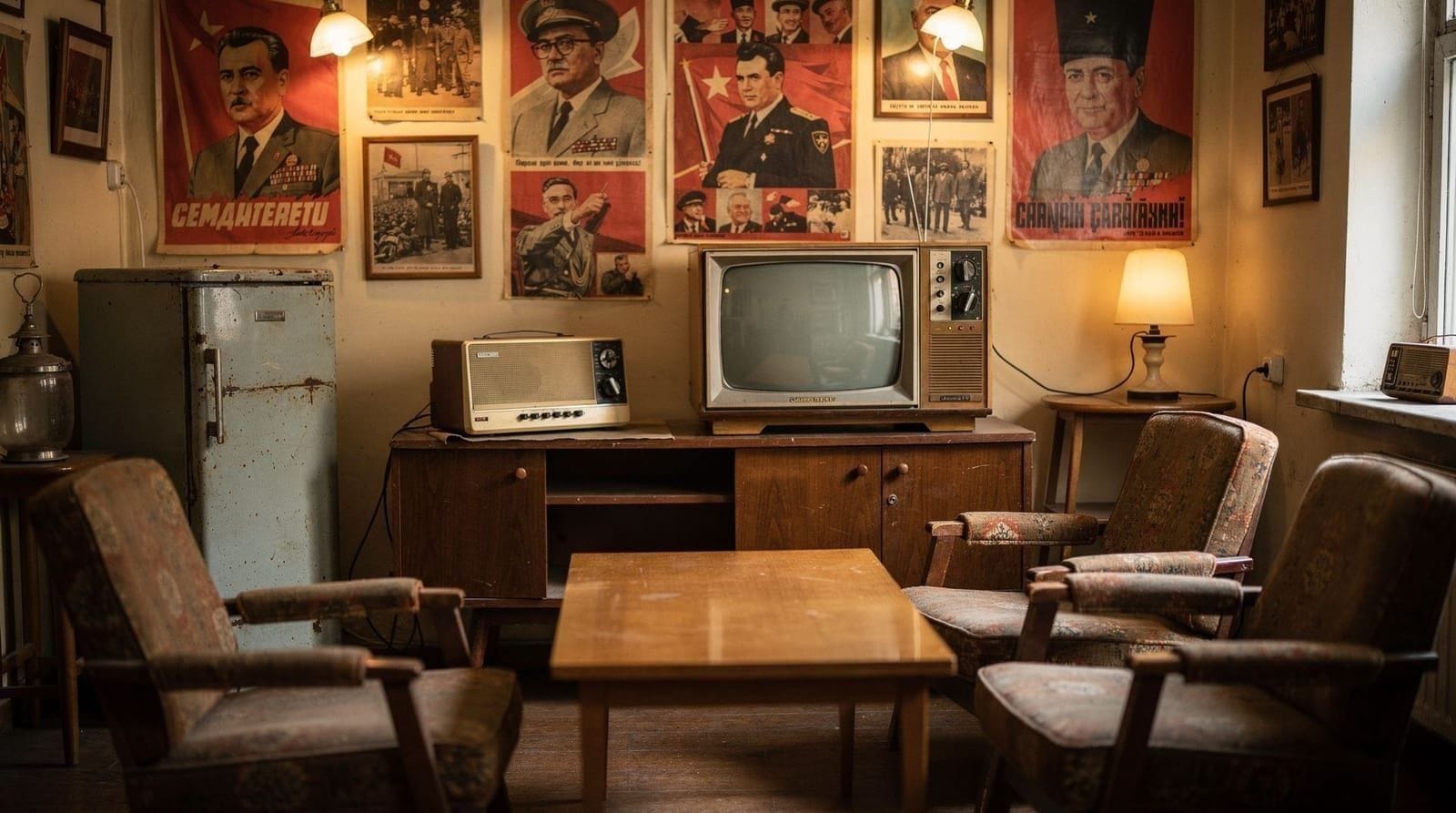
Alternatively, couple the parliament visit with the Museum of Communism, a private museum nearby on Calea Victoriei that does a better job of explaining daily life under the regime through objects and personal testimonies.
The Palace of Parliament guide on this site covers the history in depth if you want to read before your visit.
Honest verdict
The Palace of Parliament is genuinely worth visiting once. It is overwhelming in scale, disturbing in context, and one of the most singular buildings of the 20th century. The experience is much richer with a knowledgeable guide. Skip-the-line booking is nearly always worth it between May and October. The private VIP tour is excellent if you have 2+ hours and a real interest in the subject.
What to be cautious about: some cheaper tours on booking platforms rush through in under 45 minutes to push more groups through per day. Read reviews carefully. The better-rated options give 1–1.5 hours minimum.
Tour with a local guide — highly rated optionThe architecture of the Palace of Parliament
The palace’s design is not accidental gigantism — it is a deliberate architectural programme with a specific political logic. In 1984, Ceaușescu chose Anca Petrescu to lead the design team. She was 26 years old when selected, an almost unknown architect, which suited a leader who wanted no challenge to his own vision of the building. Petrescu would oversee the project until Ceaușescu’s death in 1989 and remained publicly associated with it for the rest of her life.
The stylistic brief was to combine neo-Romanian motifs — pointed arches, carved limestone ornament derived from medieval Wallachian church architecture — with the scale imperatives of socialist realism. The result is a building that is neither fully one nor the other: too ornate to be pure socialist realism, too vast to read as a coherent interpretation of Romanian vernacular architecture. The contradiction is most visible in the main entrance hall, where carved stone arches of vaguely medieval derivation rise to vast coffered ceilings sized for a building 20 times their cultural reference point.
The construction constraint that most shaped the result was Ceaușescu’s insistence on exclusively Romanian materials. No stone, marble, wood, or chandelier crystal was to be imported. This rule produced a remarkable mobilisation of Romanian industry: 1 million tonnes of Romanian marble from Ruschița and other Carpathian quarries were cut and installed. The chandeliers — 480 in total throughout the building — were manufactured in Romanian glass factories, some of them weighing 2 tonnes each. The 3,500 tonnes of crystal used in lighting fixtures came from Romanian production.
The carpet in the Union Hall deserves specific attention. At 2,200 square metres, it is documented as the largest carpet in the world — it was woven in situ because no conventional loom could have produced it and no door could have admitted it. Weavers worked on the floor of the hall itself. The carpet is still in place and is one of the more genuinely astonishing things in the building when you know its production method.
The building consumed an extraordinary volume of skilled labour. At peak construction, 700 architects and 20,000 workers were on site daily, working in three shifts around the clock. Many were conscripted — military units did significant quantities of the heavy work, particularly the underground floors.
The political context: what the palace cost Romania
The Palace of Parliament was not built in isolation from the Romanian economy — it was built in competition with it, and the economy lost badly.
Construction began in 1984 at the height of Romania’s debt crisis. Ceaușescu had committed to repaying the country’s entire foreign debt — roughly 10 billion dollars — by the end of the decade. To generate the hard currency needed, Romania exported almost everything it produced: grain, meat, oil, manufactured goods. The domestic result was rationing. Romanians in the 1980s faced queues for basic staples — bread, cooking oil, sugar, meat — that were inadequate even when they were available. Power was rationed to 2 hours per day in many homes during winter. Heating was cut to minimal levels. Petrol was rationed. This was not a wartime economy — it was the peacetime result of a political decision to prioritise debt repayment and monumental construction over domestic consumption.
The palace consumed an estimated 40% of Romania’s state construction budget in some years during the mid-to-late 1980s. The exact GDP figure is debated by economists, but the direction is not: the building diverted capital and labour at a time when ordinary Romanians were cold and underfed.
The human cost had a geographic dimension. The building sits on the former Uranus neighbourhood, a historic residential and commercial area of Bucharest. Its construction required the demolition of a 4 km by 4 km section of the city and the forced relocation of approximately 40,000 people. Residents were given 2 weeks to vacate their homes, sometimes less. The demolished area contained thousands of historic apartment buildings, houses, and public buildings accumulated over centuries. Among the specific losses: 19 Orthodox churches, 3 synagogues, a dozen monasteries, and significant sections of Bucharest’s interwar architectural fabric.
The building was called the Casa Poporului — the People’s House. Romanians were not invited inside during the Ceaușescu years. After 1989 it was renamed and partially repurposed as the seat of the Romanian Parliament, but the majority of its 1,100 rooms remain unused or in storage.
After your visit: what to do nearby
The area immediately surrounding the palace rewards some exploration after the tour.
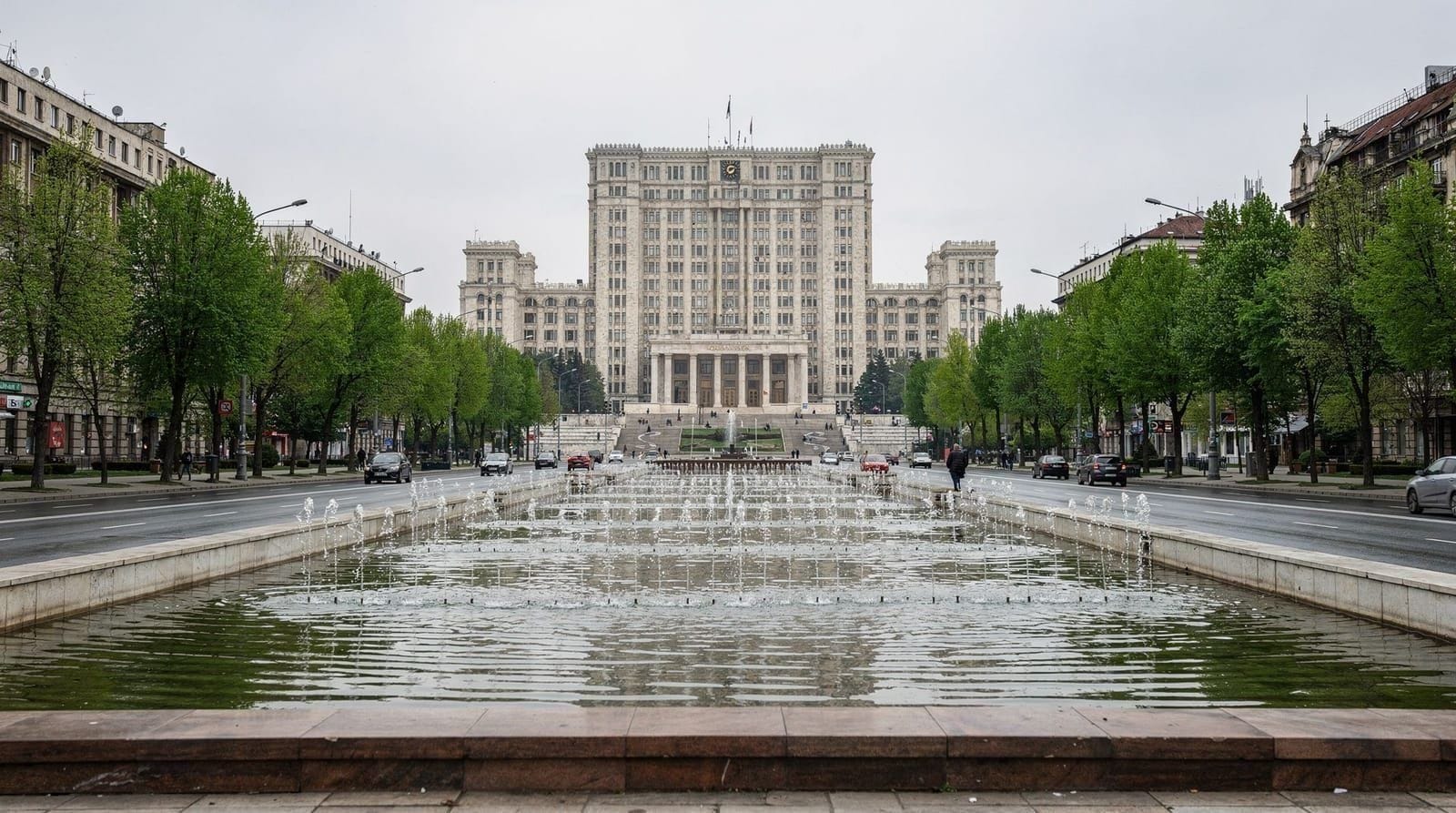
Piața Unirii fountains — at the eastern end of Bulevardul Unirii, the long Haussmann-inspired boulevard that Ceaușescu created to frame the palace. The fountains are the largest in Romania, fed by 12 artesian wells. They are illuminated at night. The boulevard itself, though designed as a propaganda statement (modelled loosely on the Champs-Élysées but wider), gives the best unobstructed view of the palace from a distance and makes the scale readable in a way that standing at the entrance does not.
The National Museum of Contemporary Art (MNAC) occupies the west wing of the palace — entered separately from the tour route, through a different gate. It holds a collection of Romanian and international contemporary art from the post-1989 period, with rotating exhibitions. Entry is typically 15–25 RON. The contrast between the communist-era architecture of the building and the post-communist art inside it is not subtle, but it is interesting. Hours vary; check before combining with the palace tour.
Calea 13 Septembrie — the street running south from the palace entrance, lined with mid-range restaurants and cafés. Several are targeted at the parliamentary staff who work in the building, which keeps prices reasonable by Bucharest city-centre standards. Good for a sit-down lunch after a 1–1.5 hour tour. Avoid eating at the few tourist-facing spots immediately adjacent to the Gate 1 entrance, which charge a premium for the location.
The view from the palace steps looking northeast along Bulevardul Unirii toward Piața Unirii is one of the set-piece urban vistas of Romania and worth photographing before you leave. The scale of the boulevard is the point — it was designed to dwarf the individual and frame the palace, which it does effectively even 35 years after Ceaușescu’s death.
Ticket options compared
| Ticket type | Price (per person) | Queue | Guide included |
|---|---|---|---|
| Walk-up entry | 85 RON | 45–60 min in summer | No |
| Skip-the-line | 90–110 RON | None | No |
| Guided group tour | 120–160 RON | None | Yes, shared (up to 25) |
| Private guided tour | 160–250 RON | None | Yes, dedicated |
What happened to the rest of the building
Only a small fraction of the Palace of Parliament’s 1,100 rooms are in active use, and understanding what fills the rest of the building adds useful context to the guided route. The Romanian Chamber of Deputies and Senate occupy a working section, with government offices distributed across several more floors — this is a functioning seat of national government, not a museum piece, which is part of why access is restricted and photography rules exist in the chambers themselves.
Beyond the parliamentary offices, large sections remain essentially as they were left after 1989: unused, unfurnished, and in some cases unfinished. Underground, the building’s 8 subterranean levels were originally designed with a nuclear-hardened bunker and extensive tunnel systems intended to connect to other government buildings and potentially the metro system — a legacy of Cold War-era planning for regime continuity that tour guides sometimes mention but that visitors do not see, since these areas remain closed to the public. The scale of unused space is itself part of the palace’s story: a building conceived at a scale that even a national government has struggled to fully occupy or repurpose in the 35+ years since Ceaușescu’s fall.
Pairing with the Museum of Communism and the wider city
Visitors building a communism-focused day should sequence the Palace of Parliament in the morning, when it is coolest to queue and light for photography is best on the exterior boulevard, then move to the Museum of Communism in the afternoon for the human-scale counterpoint. The Ceaușescu’s Bucharest guide ties the two together with the broader Civic Centre context, and the 1989 revolution sites guide rounds out the day if time allows a stop at Piața Revoluției afterwards.
Frequently asked questions about the Palace of Parliament tour
Do I need a guided tour to visit the Palace of Parliament?
No — you can buy an entry ticket at the door, but queues are long in summer. A skip-the-line ticket costs a little more and is worth it on busy days. A guided tour adds context that most visitors find considerably more valuable than the marble staircases alone.
How long does the Palace of Parliament tour take?
Standard guided tours last about 1 hour covering the main halls. Extended or VIP private tours run 1.5–2 hours and access restricted areas such as the Nicolae Iorga Hall and Senate chambers.
Can I photograph inside the Palace of Parliament?
Photography is permitted in most public areas without flash. Some ceremonial halls restrict tripods. Video filming for commercial use requires a separate permit.
What is the best time to visit to avoid crowds?
Weekday mornings (9:00–11:00) are quietest. Saturday afternoons between June and August are the most crowded. Book a skip-the-line ticket regardless of timing.
Is the Palace of Parliament accessible for visitors with mobility needs?
Yes, lifts access main floors and ramps are available at the main entrance. Notify your tour operator in advance if you need wheelchair assistance. Restrooms are available near the entrance and at intervals along the route, though not densely distributed given the building’s size — plan accordingly with young children. A cloakroom at Gate 1 handles bags and coats that exceed what is allowed inside the ceremonial halls; large backpacks and rolling luggage must be checked before entry.
Is a private guided tour worth the extra cost?
If you have a genuine interest in Romania’s communist history or architecture, yes. Private tours (150–250 RON / 30–50 EUR per person) allow questions in real time and typically cover more floors than group tours.